Assembly Line

From Problem to Production

A tailored, iterative process that delivers business value at every step.

Our 5-Step Process

Every engagement follows the same proven path -- tailored to your situation and needs.

Understand the Problem

Grasp your business, build common understanding

Scope & Breakdown

Define boundaries, decompose the domain

Design The Solution

Co-design triggers, reactions, information flow

AI-Native Build & Test

Human-guided, AI-driven development with automated testing

Run & Support

Integration, managed services, knowledge transfer

Process Characteristics

Not a rigid framework -- a living process shaped by your reality.

Iterative

The five steps are not a one-shot sequence. We revisit them as the project evolves -- incorporating new insights, responding to business changes, and progressively deepening the solution with each iteration.

Tailored

Our software factory is highly customised to your context. The output aligns with your corporate standards, architecture and technology choices, and integrates seamlessly into your existing environment.

Integrated Team

No handovers, no "lost in translation". Business and IT collaborate side by side throughout the project, connected by visual techniques and the ubiquitous language of Domain-Driven Design.

1

Understand the Problem

We start by deeply understanding your business. Before writing a single line of code, we immerse ourselves in your domain -- speaking your language, studying existing systems, and building a shared understanding with all stakeholders.

We use collaborative visual modeling techniques to discover the business domain, define the scope of the project, and build a ubiquitous language that the entire team shares.

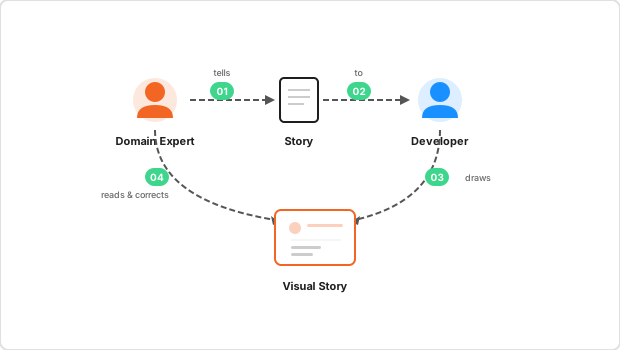
Domain Storytelling

Domain experts tell their stories and we capture them visually, building a shared language for the whole team.
Domain Storytelling

Event Storming

Collaboratively explore domain events, commands, and actors to build an end-to-end overview of the business.
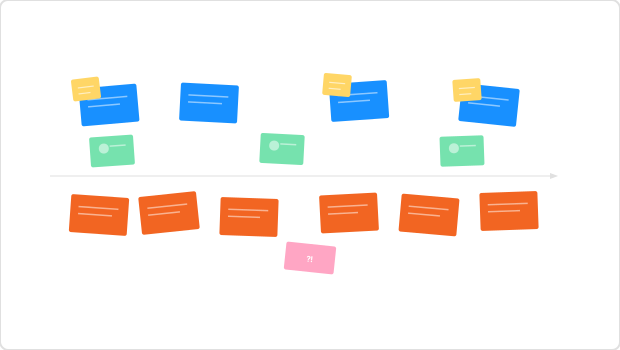
Event Storming
2

Scope & Breakdown

With a shared understanding of the domain in place, we decompose it into subdomains and define clear boundaries. We distinguish what is a strategic differentiator -- your core subdomains -- from supporting and generic ones. This distinction drives investment decisions, team topologies, and architectural decomposition, grounding both project organisation and software architecture deeply in business reality.

Event Storming

Surface pivotal events and natural boundaries to decompose the domain into well-scoped subdomains.

Event Storming

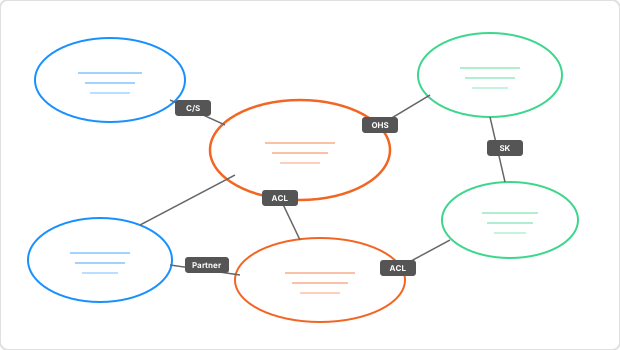
Context Mapping

Define bounded contexts and their relationships to establish clear responsibilities, integration patterns, and team boundaries.

Context Mapping
3

Design The Solution

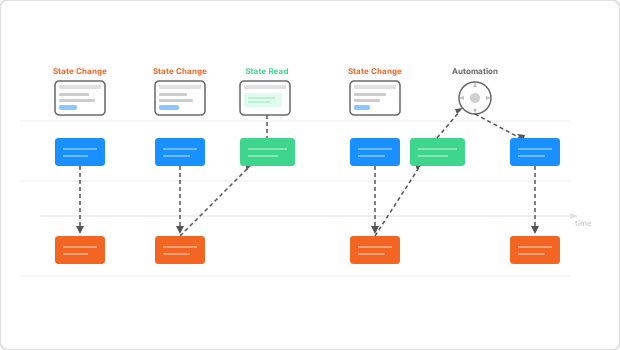
We co-design the solution together using Event Modeling -- a visual, collaborative blueprint that captures triggers, commands and the domain events they raise, business rules and invariants. This gives a clear overview of the end-to-end information flow and allows an information completeness check. The overall solution is designed as a discrete set of feature slices, each corresponding one-to-one to a feature that can be built and tested in any order. The model translates directly to code, serving as both specification and living documentation.

Event Modeling

A visual blueprint where business and technology meet. UI screens, commands, domain events, read models, and automations are laid out on a timeline -- making every feature slice visible, verifiable, and directly translatable to code.

Event Modeling

The result is a crisp, unambiguous specification with no room for interpretation issues or misalignment. Everyone understands exactly what will be built and what won't, with the freedom to change, extend, reduce, or re-prioritize at any time.

4

AI-Native Build & Test

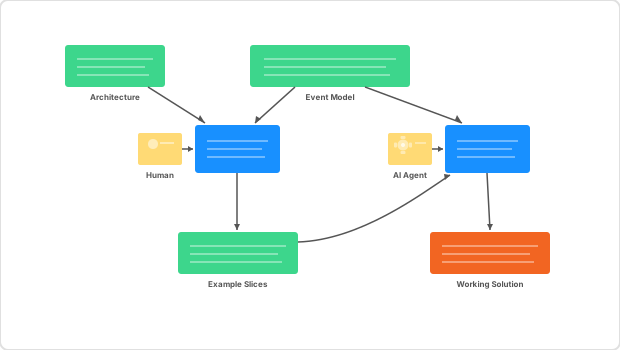
We combine human expert development and AI agentic development. Human developers craft exemplary feature slices that set the standard for the project -- reflecting the architecture landscape, platform choices, company standards, and non-functional requirements. AI agents then realise additional feature slices fully in line with these examples, under human-in-the-loop supervision.

Feature slices can be built and tested in any order. And when changes are needed, the impact is highly predictable and easy to apply, thanks to the repetitive character of a limited set of simple, well-understood patterns.

AI-Native Build Process
5

Run & Support

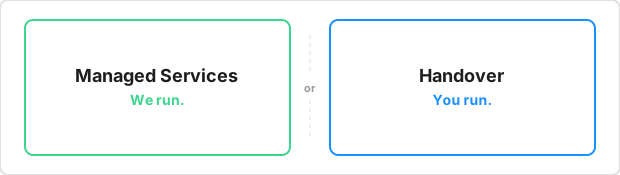
We don't walk away after delivery. Your software is integrated into your environment, monitored, and supported. Whether you need managed services or a full handover, we tailor the support model to your needs.

Managed Services or Handover

In either case, you benefit from built-in monitoring and observability, side-effect free maintenance through isolated slices, and a solution that is ready to embrace future requirements without degradation of solution quality.

Ready to start your project?

Explore our services or get in touch to discuss how we can tailor this process to your needs.